History
Half Moon Bay is San Mateo County's oldest town. Over two centuries it has been called San Benito, Spanishtown and Halfmoon.


A short history of Half Moon Bay
Half Moon Bay is San Mateo County's oldest town. Over two centuries it has been called San Benito, Spanishtown and Halfmoon. It has made its living from cattle, artichokes, pumpkins, flowers, fishing and, briefly, smuggled whisky. This page tells that story in short, with a link to the source for every claim. For the full texts of the old county histories, see the reading list.
The first people
For thousands of years before Europeans arrived, Ohlone people lived along the San Mateo coast. They lived in small, scattered villages, because the coast could feed only so many people [1]. At the Fitzgerald Marine Reserve in Moss Beach, people were living about 5,800 years ago [2]. Mission records say the local Chiguan Ohlone called the Princeton area Ssatumnumo and had a second village, Chagunte, near today's Half Moon Bay [3]. An Ohlone archaeological site is recorded on the bluff above Pillar Point Harbor [4].
Portolà and the geese, 1769
The first European land expedition into Alta California, led by Gaspar de Portolà, came up this coast in the autumn of 1769. On 28 October it camped beside the creek that runs through town today. The diarist, Father Juan Crespí, named the creek Arroyo de San Simon y San Judas for that day's feast [5]. He also noted that the soldiers called the plain Los Ansares, "the geese", because there were so many of them [1]. By 1836 the creek had the name it still carries, Arroyo de los Pilarcitos, "the creek of the little pillar-like rocks" [5].
Mission pasture and Mexican ranchos
After Mission San Francisco de Asís (Mission Dolores) was founded in 1776, the coast became pasture for the mission's cattle, horses and oxen [6]. When the missions were secularised in the 1830s, the land was granted out as ranchos. North of Pilarcitos Creek was Rancho Corral de Tierra ("earthen corral"), granted in 1839, whose southern part went to Tiburcio Vásquez [7]. South of the creek, Governor Juan B. Alvarado granted the 4,424-acre Rancho Miramontes (also called Rancho San Benito) to Candelario Miramontes in 1841 [8]. The Vásquez and Miramontes families settled on opposite banks of the Pilarcitos. In 1883 a county history described the town as having "the air of age and ante-American times about it" [9].
San Benito, Spanishtown, Half Moon Bay
The settlement grew in the 1840s as the county's first real town, under the name San Benito [6]. It was then called Spanishtown, a mixed community of Californios and Mexicans joined by Canadians, Chinese, English, Germans, Irish, Italians, Scots, Portuguese and Pacific Islanders [6]. Americans arriving in the 1850s called it "Halfmoon", after the crescent-shaped bay [1]. The post office was listed as Halfmoon Bay in 1867, and the town was officially renamed Half Moon Bay in 1874 [6]. The spelling settled as three words in 1905 [1].
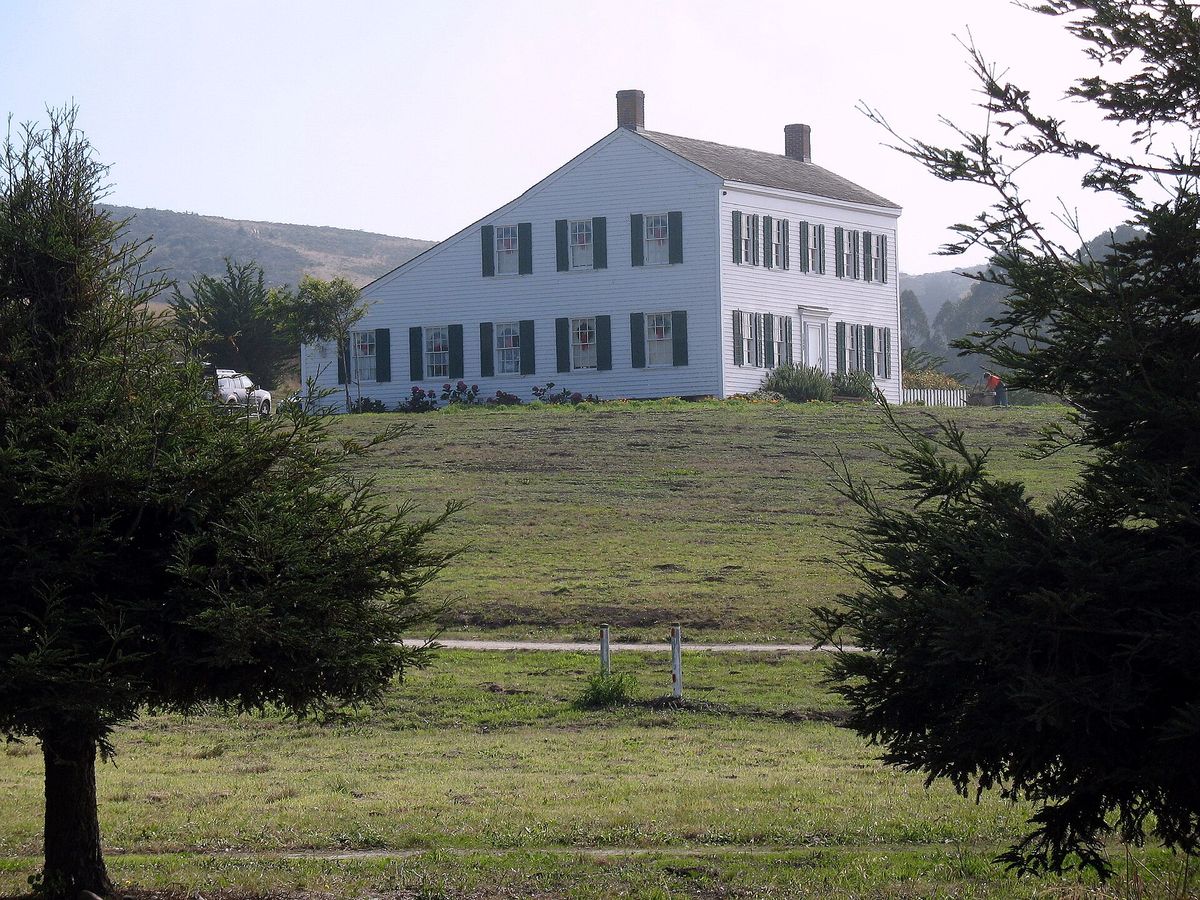
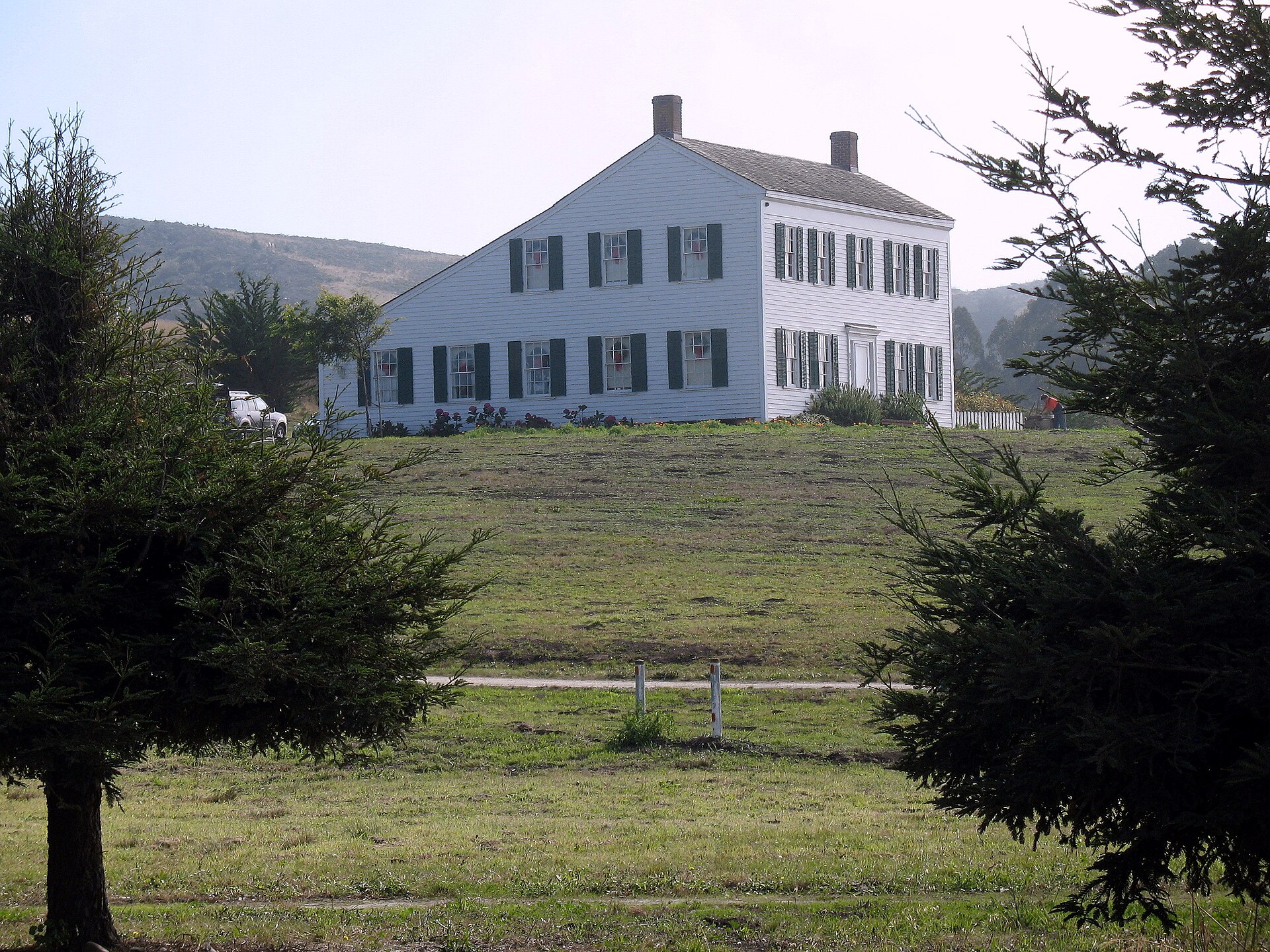
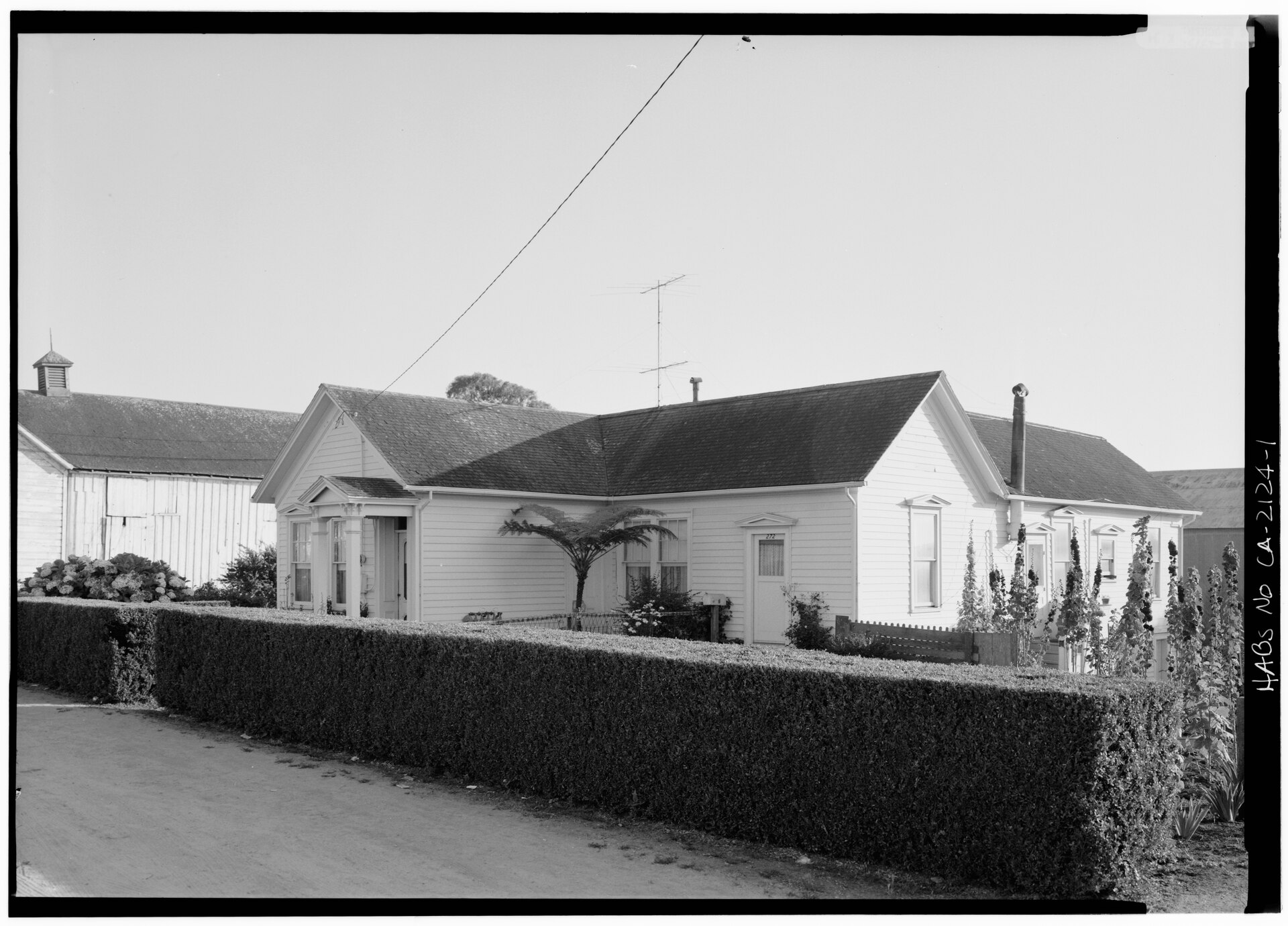
The newcomers bought into the old ranchos. In 1853 James Johnston bought 1,162 acres of Rancho Miramontes. He built the first wood-framed house on the San Mateo coast, a New England saltbox, and it still stands at the south end of Main Street [8]. Stagecoaches linked the town with San Mateo and ran south to Purissima, Lobitos and San Gregorio [6]. Levy Brothers opened a store downtown in 1872 [10]. Today Purissima survives only as remains near Highway 1 and Verde Road, perhaps the county's only ghost town [6].
At Pillar Point, James Denniston built a deep-water landing that for years shipped lumber and produce to San Francisco [4]. This coast was hard on ships. The Rydal Hall was wrecked near the point in 1876, and its anchor is still on display by the harbor [4]. The 1889 federal Coast Pilot warned that sailing vessels anchored in the bay "should be ready to go to sea on the approach of bad weather" [11].
Main Street takes shape
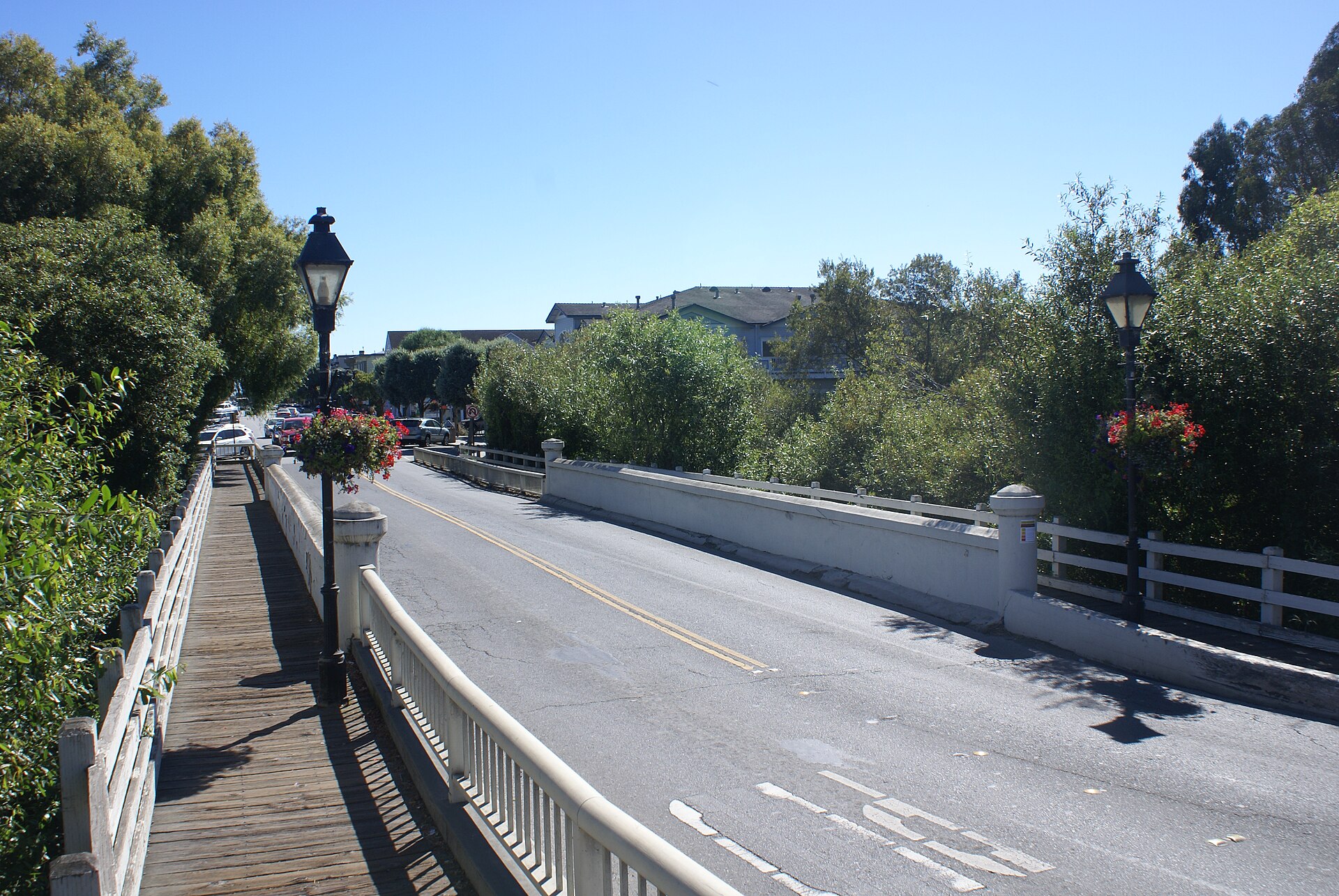
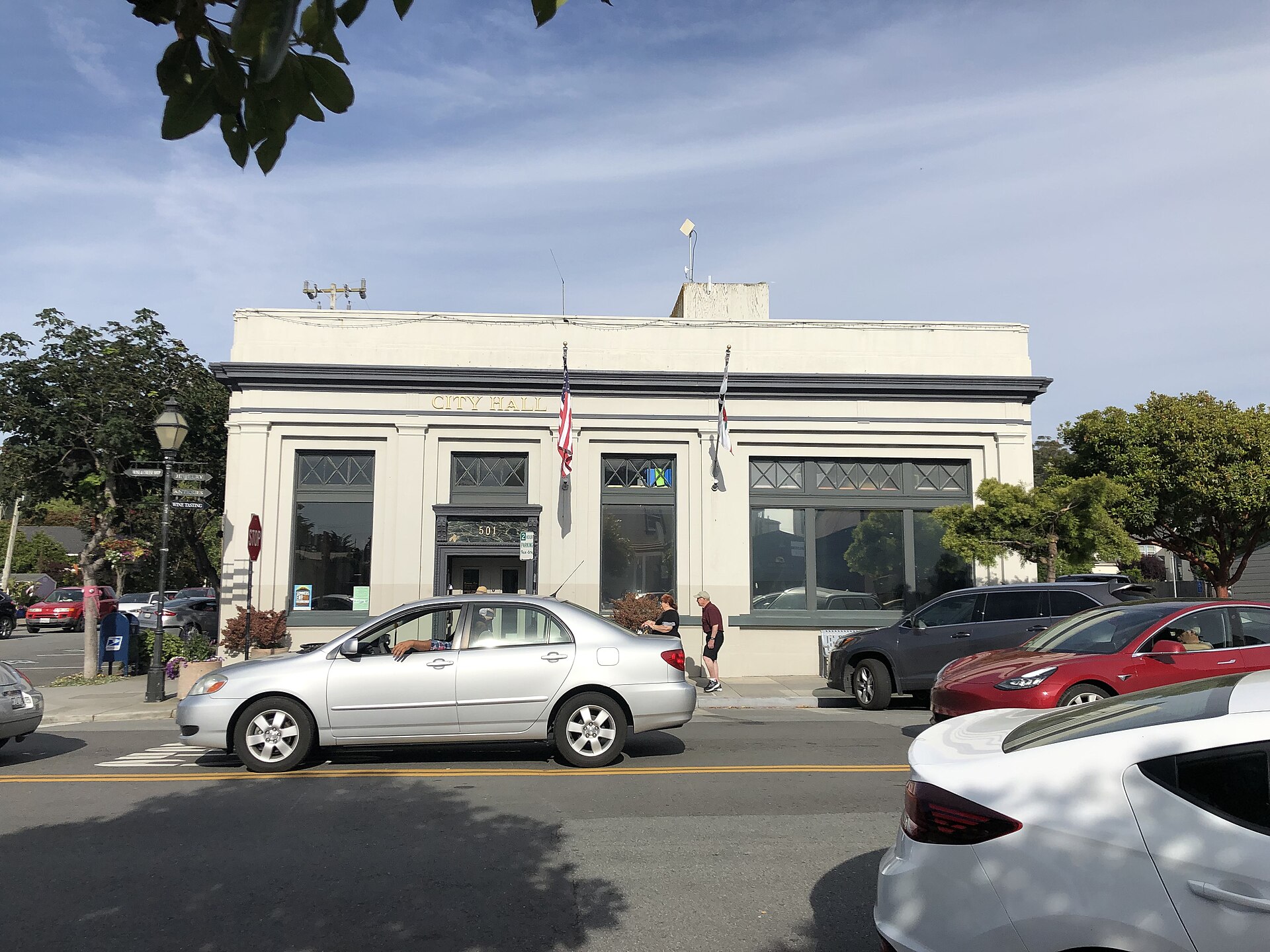
Much of downtown dates from this period. Giuseppe Boitano's general store and saloon of 1873 is the town's oldest place of continuous retail business [12]. The Methodist church on Miramontes Street, built in 1872, is the oldest church still standing [12]. The bridge over Pilarcitos Creek, built in 1900, was the first steel-reinforced concrete bridge in the county, and it was reinforced with used San Francisco cable-car cables [12]. The building that is now City Hall opened around 1922 as the Bank of Half Moon Bay [12]. The Half Moon Bay Review has reported on the Coastside since 1905 [13].
Artichokes, sprouts and the railroad
Farming carried the town into the twentieth century: Brussels sprouts, artichokes, mushrooms and dairy [1]. By 1916 a county history boasted that Half Moon Bay artichokes were "known from San Francisco to New York", and that the town had the largest mushroom farm west of Chicago [14].
The Ocean Shore Railroad was supposed to run all the way to Santa Cruz. The 1906 earthquake and money troubles stopped it, and it ran as two separate pieces [15]. Trains reached Half Moon Bay in 1907. When Pedro Mountain Road opened a better route to San Francisco in 1914, the railroad lost much of its reason to exist, and it was gone by 1920 [6].
Prohibition on the foggy coast
Fog, hidden coves and a thirsty San Francisco nearby made the Coastside ideal for bootlegging from 1920 to 1933. The Coast Guard's own history says Half Moon Bay was "excellent for clandestine operations" [16]. In 1924 the British steamer Ardenza lay off the bay for seven months with 25,000 cases of Scotch, and contact boats ran 18,000 of them to San Francisco [16]. Francis Beach was a favourite landing spot [1]. Roadhouses served what came ashore. Frank Torres's place on the Moss Beach bluffs, built in 1927, is now the Moss Beach Distillery, and Dashiell Hammett was among its regulars. The Miramar Beach Restaurant began as the Ocean Beach Tavern, which had revolving kitchen cabinets for hiding liquor [17].
War, a harbor and a city
World War II brought soldiers to the beach. Pillar Point Military Reservation was set up in 1940 with guns, searchlights and later radar to guard the approach to San Francisco [18]. In 1942 an Army airfield was built between Princeton and Moss Beach, and it is now Half Moon Bay Airport [19]. After the war, new subdivisions brought the growth that led to the city's incorporation in 1959 [6]. Between 1959 and 1961 the Army Corps of Engineers built the Pillar Point breakwater, which was extended in 1967 and completed by an inner breakwater in 1982 [4].
Pumpkins
In 1971 the Main Street Beautification Committee needed money to fix up a fading downtown, and the town was surrounded by pumpkin patches. The result was the first Art and Pumpkin Festival, which drew 30,000 people [20]. In the early 1970s Circleville, Ohio challenged Half Moon Bay for the title of Pumpkin Capital of the World, and the two towns held a weigh-off by phone [21]. The weigh-off is now held each Columbus Day Monday. Its 2023 winner weighed 2,749 pounds, and in 2019 it was named the world's top weigh-off site [20].
Mavericks
From Half Moon Bay High School, a teenage Jeff Clark could see giant waves breaking off Pillar Point. In 1975, at 17, he paddled out alone and rode them. He then surfed the break by himself for fifteen years [22][23]. It was named after Maverick, a German Shepherd who swam out after his owner's friends in 1967 [23]. Once a photo appeared in Surfer in 1990, the world's big-wave riders arrived [23]. In 1994 the Hawaiian surfer Mark Foo drowned there [23]. Sarah Gerhardt became the first woman to ride it in 1999, and from 1999 to 2016 the invitation-only Titans of Mavericks contest ran there whenever the waves allowed [23].
Key dates
01
1769
Portolà camps by the creek
The first European land expedition into Alta California camps beside Pilarcitos Creek on 28 October. Source ↗
02
1841
Rancho Miramontes
Governor Alvarado grants 4,424 acres south of the creek to Candelario Miramontes. Source ↗
03
1853
The Johnston House
James Johnston buys 1,162 acres and builds the coast's first wood-framed house, a New England saltbox. Source ↗
04
1874
Spanishtown becomes Half Moon Bay
San Benito, then Spanishtown, is officially renamed Half Moon Bay. Source ↗
05
1900
The cable-car bridge
The Main Street bridge over Pilarcitos Creek, reinforced with used San Francisco cable-car cables. Source ↗
06
1907
The Ocean Shore Railroad arrives
Trains reach Half Moon Bay; the line never reaches Santa Cruz and is gone by 1920. Source ↗
07
1924
The Ardenza
A British steamer with 25,000 cases of Scotch lies off the bay for seven months during Prohibition. Source ↗
08
1959
A city
Half Moon Bay incorporates; work starts on the Pillar Point breakwater. Source ↗
09
1971
The first Pumpkin Festival
Raised to fix up Main Street, it draws 30,000 people. Source ↗
10
1975
Mavericks
Seventeen-year-old Jeff Clark paddles out and rides the break alone. Source ↗
11
2023
2,749 pounds
The heaviest pumpkin ever to win the Half Moon Bay weigh-off. Source ↗
Sources
1. Half Moon Bay State Beach — Wikipedia
2. Fitzgerald Marine Reserve — Wikipedia
3. Princeton-by-the-Sea, California — Wikipedia
4. Pillar Point Harbor — Wikipedia
5. Pilarcitos Creek — Wikipedia
6. Half Moon Bay, California — Wikipedia
7. Rancho Corral de Tierra — Wikipedia
8. Rancho Miramontes — Wikipedia
9. History of San Mateo County, California (B. F. Alley, 1883) — Internet Archive
12. Half Moon Bay's Main Street — Visit Half Moon Bay
13. Half Moon Bay Review — Wikipedia
14. History of San Mateo County from the Earliest Times (1916) — PDF
15. Ocean Shore Railroad — Wikipedia
16. Rum War at Sea (Malcolm F. Willoughby, U.S. Coast Guard, 1964) — Internet Archive
17. The Coastside During Prohibition — Visit Half Moon Bay
18. Pillar Point Air Force Station — Wikipedia
19. Half Moon Bay Airport — Wikipedia
20. Half Moon Bay Art and Pumpkin Festival — Wikipedia
21. A California town's claim to gourd greatness — The Christian Science Monitor, 2004
Further reading
History of San Mateo County, California, B. F. Alley (publisher) (1883) — public domain, free to read online
A Memorial and Biographical History of the Coast Counties of Central California, Henry D. Barrows (editor), Luther A. Ingersoll (editor) (1893) — public domain, free to read online
History of San Mateo County from the Earliest Times, Philip W. Alexander, Charles P. Hamm (1916) — public domain, free to read online
Pacific Coast Pilot of California, Oregon and Washington, George Davidson (1889) — public domain, free to read online
Commercial Possibilities of the Oil Field at Half Moon Bay, San Mateo County, California, Eric A. Starke (1921) — public domain, free to read online
Rum War at Sea, Malcolm F. Willoughby (1964) — public domain, free to read online
A Little Journey to San Mateo County, Elbert Hubbard (1915)
Illustrated History of San Mateo County, Moore & DePue (1878) — borrow it from the Internet Archive
History of San Mateo County, California, Roy W. Cloud (1928) — borrow it from the Internet Archive
Half Moon Bay (Images of America), Kathleen Manning, Jerry Crow (2005) — borrow it from the Internet Archive
Half Moon Bay Memories: The Coastside's Colorful Past, June Morrall (1978) — borrow it from the Internet Archive
South from San Francisco: San Mateo County, California, Its History and Heritage, Frank M. Stanger (1963) — borrow it from the Internet Archive
Peninsula Portrait: An Illustrated History of San Mateo County, Mitchell Postel (1988) — borrow it from the Internet Archive
From Frontier to Suburb: The Story of the San Mateo Peninsula, Alan Hynding (1982) — borrow it from the Internet Archive
Exploring Half Moon Bay and the San Mateo Coast: The Guidebook, Nancy M. Evans, Neil A. Evans (1992) — borrow it from the Internet Archive
The Coastside Trail Guidebook: Plants, Animals, Historical Lore along Half Moon Bay, Barbara VanderWerf (1993) — borrow it from the Internet Archive
The Last Whistle: Ocean Shore Railroad, Jack R. Wagner (1974) — borrow it from the Internet Archive
Ocean Shore Railroad (Images of Rail), Chris Hunter (2004) — borrow it from the Internet Archive
Building a Community: The Story of Japanese Americans in San Mateo County, Gayle K. Yamada (2003) — borrow it from the Internet Archive
Crossroads: People and Events of the Redwoods of San Mateo County, Gilbert Richards (1973) — borrow it from the Internet Archive